THE CHALLENGE
An inbox needs actions, not only labels
A busy inbox mixes incidents, support requests, newsletters, and phishing. Choosing a label does not resolve that workload. EETRE asks whether an agent can choose and carry out the next useful action: reply, escalate, archive, or mark spam.
ENGINEERING
Grading the next action in a workflow
The environment exposes reset, state, and step operations. An observation includes the task objective, difficulty, inbox, processed message IDs, and step budget. Each action updates the episode history and produces a structured reward and completion state.
The grader considers action correctness, response content, and efficiency. It penalizes unsafe replies to spam, repeated work, missed replies, unmet task dependencies, and repeated-action collapse. Optional reward noise is configurable, with a seed for reproducible noise.
The live-agent workflow separates reasoning, decision, and audit stages. Configured integrations can read and act on a mailbox through IMAP/SMTP and escalate to Slack. The repository also contains a simpler rule-based orchestrator; its behavior should not be confused with learned-model performance.
Grade the workflow, not just the label
Episode state tracks processed emails, action history, dependencies, and remaining steps. Response quality uses explicit keyword and length checks rather than a claim of comprehensive semantic evaluation.
Keep training and execution boundaries visible
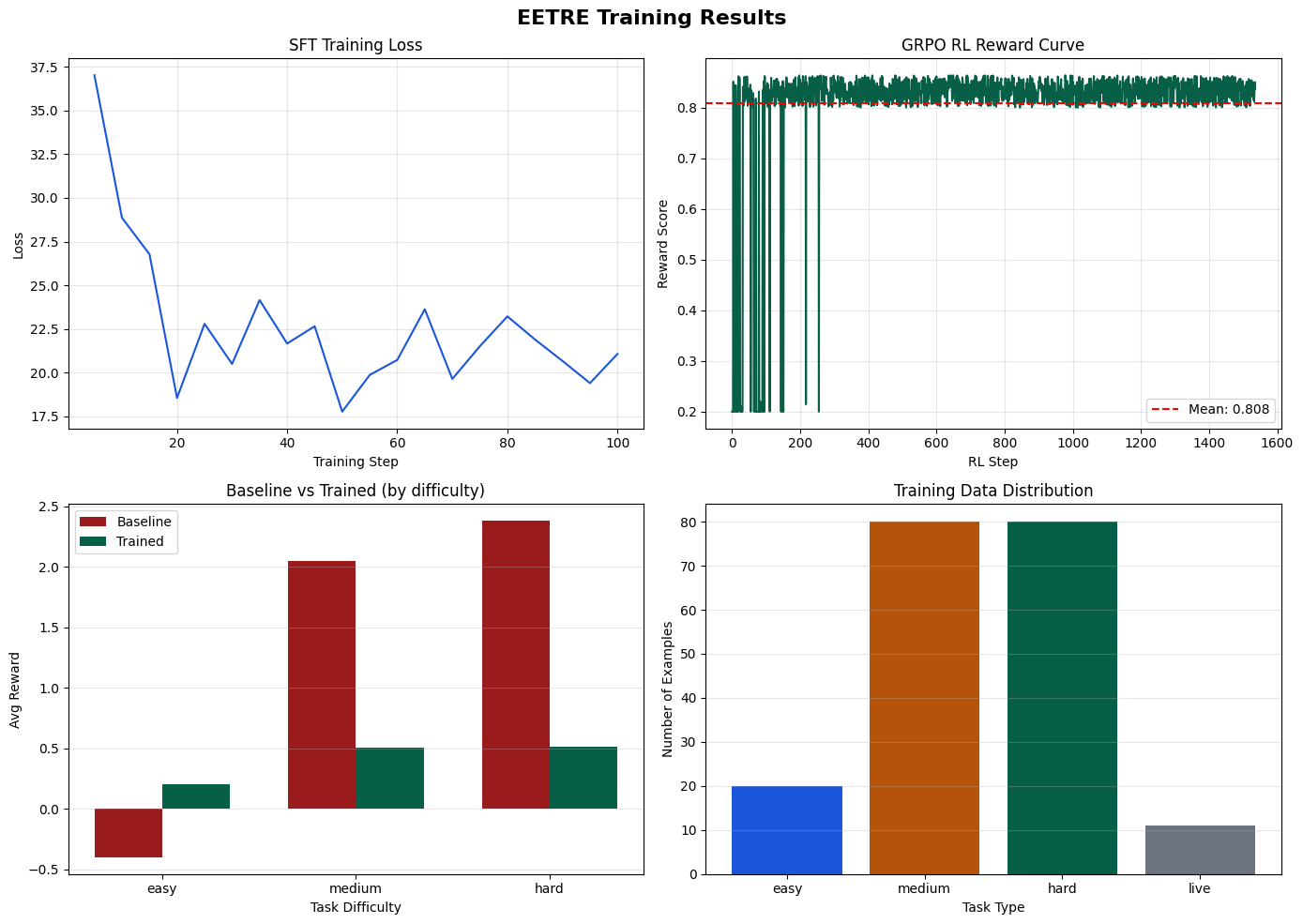
The simulated curriculum supplies bounded tasks; live-mail integration is a separate configured path. GRPO training uses the environment API.
Inspect the evidence by run
Training plots, response examples, and escalation screenshots are archived in the repository. They document experiments rather than guarantee performance on every inbox.